
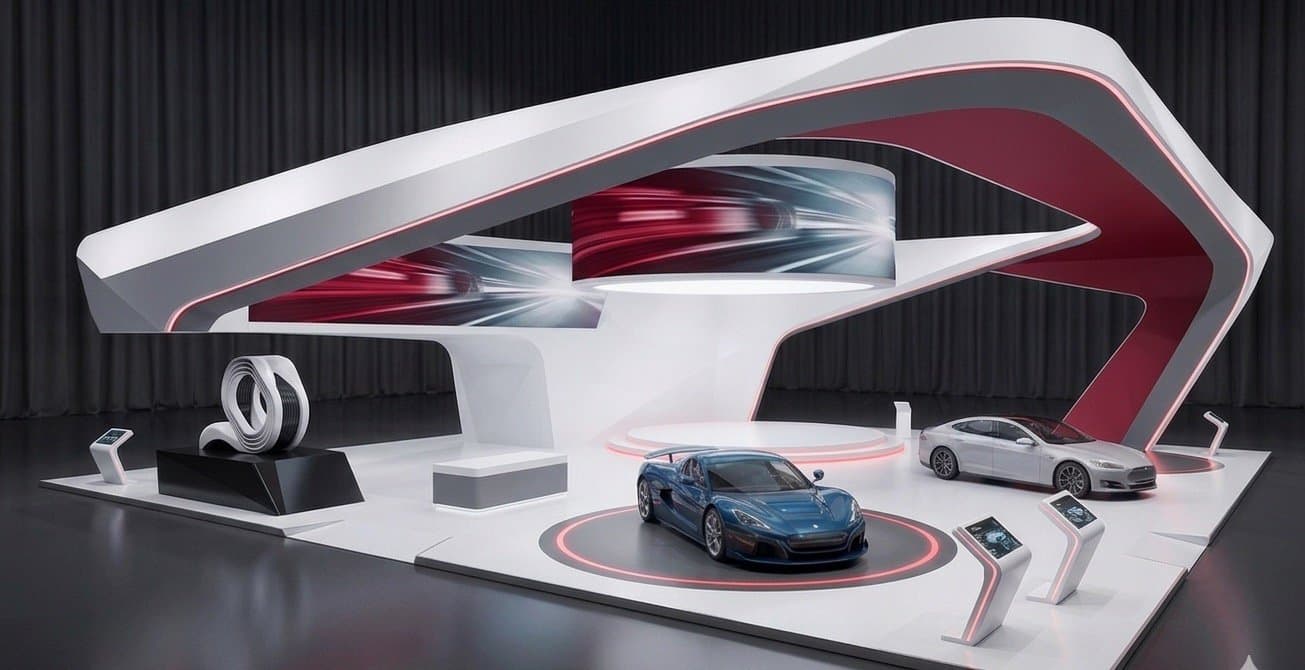
Behind Every Successful Show: The Logistics No One Sees
Visitors remember the show. They remember the car they sat in, the demo that surprised them, the queue that moved faster than expected. They never think about the loading dock schedule, the rotation plan for a 20,000-vehicle parking lot, or the rigging crew that finished its work at four in the morning so nobody would ever see it happening. That invisibility is the entire point of good event logistics — and also the hardest part of the job.
At Integration Solutions Co., logistics isn't the department that reacts when something goes wrong on-site. It's the layer of planning that determines whether anything goes wrong at all, months before a single visitor walks through the gate.
Every show runs on three distinct logistics layers, and most of the risk sits in the handoffs between them. Pre-show build: trade sequencing where electrical infrastructure must be certified before flooring, flooring before branded walls, walls before furniture and signage arrive. Live-show operations: crowd flow, parking and shuttle rotation, security staffing, way-finding, and a response plan for the dozens of small issues that come up in any four-day event. Post-show teardown: the reverse of the build in a fraction of the time — reverse logistics for exhibitor materials, waste and recycling, venue handback, and asset storage for reuse.
Our flagship event, the 20th-edition Jeddah International Motor Show, runs 4–7 November 2026 at the Jeddah Center for Exhibitions and Events — 16,000 square meters of indoor and outdoor space with a 6,000-square-meter exhibition hall at its core. With up to 300,000 visitors expected across four live days and an average dwell time of roughly two and a half hours per visit, the 20,000-vehicle parking capacity has to turn over multiple times a day — which only works if the rotation is modelled in advance, not managed reactively once cars start backing up onto the access road.
A dedicated Press Day, with more than 100 journalists expected to attend, adds its own logistics layer entirely: media accreditation, a separate access window before the public gates open, interview staging, and a different security and hospitality plan than the one built for four days of public footfall. Treating that as 'the same show, just earlier' is how press-day logistics quietly breaks on launch morning.
The temptation with logistics is to treat it as an administrative task — a list of vendors, a schedule, a floor plan. In practice, every major exhibition is a web of interdependencies that a checklist alone can't capture. A rigging contractor can't start until the hall's power certification is signed off. A branded-wall installer can't start until raised flooring is complete. A sponsor's agreed signage placement has to be physically delivered on schedule, in the agreed location, with the agreed visibility, or it becomes a contractual problem on top of an operational one.
Most of the cost of weak logistics never shows up as a single dramatic failure — it shows up as a string of smaller ones that compound. A trade that runs four hours late on day one of the build pushes every trade behind it, usually meaning overtime rates to catch up or opening the show with unfinished stands in full view of the first wave of visitors and press. A parking plan not modelled against real visitor volume means visitors arriving late, missing the opening, and forming their first impression of the show in a queue rather than on the floor. These failures don't make headlines — they make renewal conversations harder the following year.
We plan and run logistics for exhibitions, conferences, and large-scale public events across formats, and hold our own flagship show to the same standard. The Jeddah International Motor Show's build, live operations, and teardown are planned as three distinct phases with their own owners, not one long to-do list. Get in touch with Integration Solutions Co. to talk through your event's logistics — by message, by call, or on WhatsApp.