Why JIMS 2026 Matters for Saudi Arabia's Automotive Future
Not every motor show carries weight beyond its own exhibition hall. Some are simply a sales channel dressed up with stage lighting. JIMS 2026, however, has spent twenty editions becoming something closer to a barometer — a recurring, high-visibility moment where the Kingdom's automotive ambitions, its institutions, and its buyers all show up in the same room, on the same four days, at the same time.
JIMS 2026's own positioning leans directly into the Kingdom's economic diversification agenda: alignment with Vision 2030, a stated focus on electric vehicle industry localization, and a mission framed around "connecting manufacturers with the region's active car buyers, investors and a rapidly diversifying market." That framing matters. It signals that JIMS is not simply asking manufacturers to sell more units in Jeddah — it's positioning itself as part of the infrastructure through which the Kingdom's automotive sector matures, from imported vehicles toward local assembly, supply chains, and talent.
Marketing language is one thing; who actually shows up is another. JIMS 2026 carries confirmed backing and participation from the Jeddah Chamber of Commerce & Industry, the Transport General Authority, the Saudi Federation of Motorcycles, and the Electric Vehicle Technologies Association. The show operates under an official license from the Saudi Conventions & Exhibitions General Authority (license 26/3054) — the formal regulatory recognition that separates a licensed national platform from an informal trade gathering.
Look closely at who sponsors JIMS 2026 and a second signal emerges. Confirmed sponsorship categories span oils, tires, insurance, and financing — the connective tissue of an automotive economy, not just the manufacturers selling the vehicles themselves. Layered sponsorship tiers (Diamond, Gold, and Strategic) with strict category exclusivity suggest a market mature enough to support dedicated automotive-adjacent sectors competing for visibility.
With up to 300,000 visitors expected — roughly 60% Saudi and 40% international — and a Press Day drawing more than 100 journalists from over 10 countries, JIMS 2026 functions as a genuine convergence point, not a purely local trade show. International journalists and brands don't allocate travel budget to attend events that don't carry regional weight. A VIP Night bringing together 1,000 professionals and guests alongside more than 50 key influencers adds a further layer of cross-border industry networking.
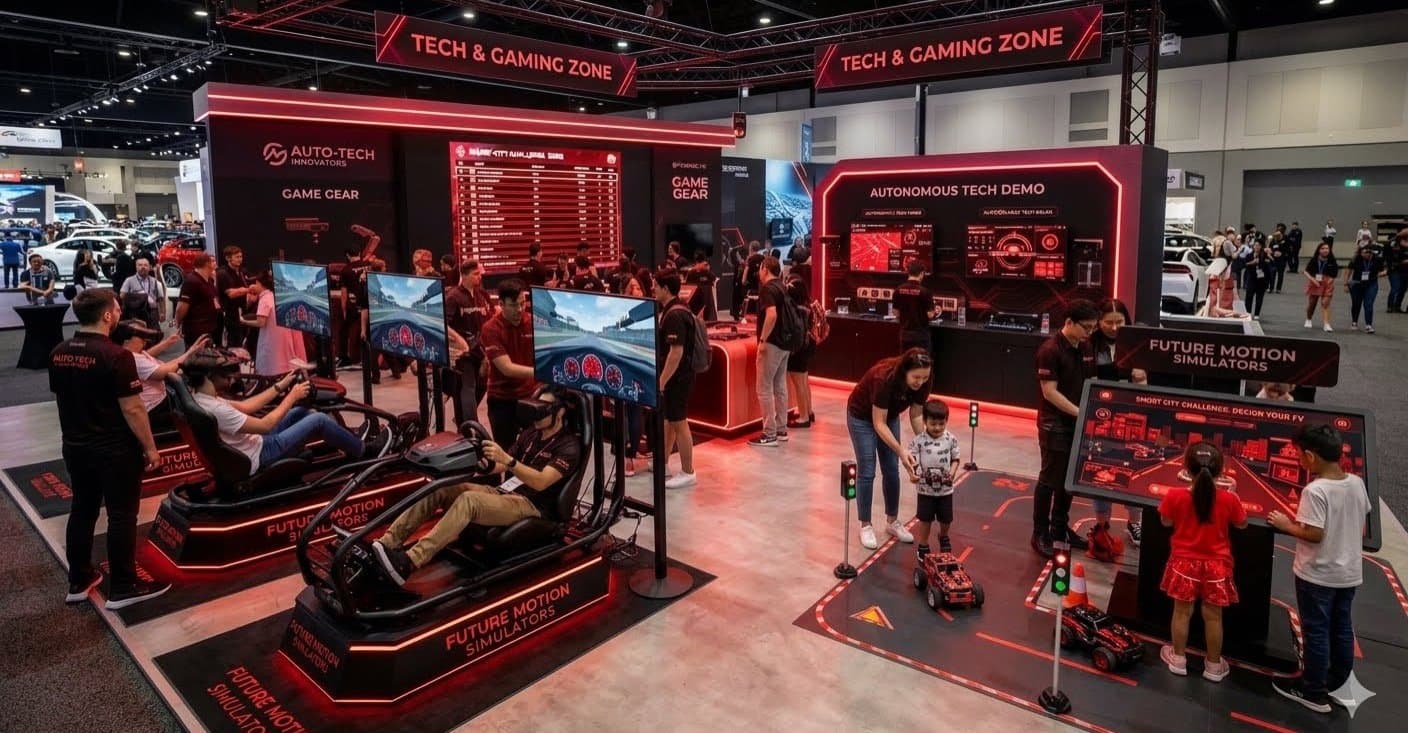
Perhaps the clearest evidence that JIMS 2026 sees itself as more than a sales event is what happens on its stage during the day: a hackathon and a VR competition aimed specifically at automotive-industry students and young innovators, running alongside the manufacturer unveilings. A show focused purely on moving inventory wouldn't dedicate stage time and competition infrastructure to the next generation of engineers and designers.
A 16,000-square-metre venue — split between a 6,000-square-metre indoor exhibition hall and substantial outdoor space at the Jeddah Center for Exhibitions and Events — isn't a scale that gets built for a modest, purely local gathering. The daily parking capacity of 20,000 vehicles and dedicated shuttle infrastructure reflect planning for crowds that a smaller regional show simply wouldn't need to accommodate.
It would be easy to read all of this as relevant only to manufacturers, policymakers, and investors — but the national significance of JIMS 2026 shapes the experience of an ordinary visitor too. A show operating purely as a sales floor would have little reason to invest in the daily workshops, panel talks, and innovation competitions that make a visit genuinely worthwhile beyond looking at cars. The institutional weight behind JIMS is part of why the show can afford to build a four-day programme this substantial.
JIMS is marking its 20th edition in 2026, which means the show has operated through multiple cycles of oil price swings, shifting consumer demand, and the industry's own pivot from combustion vehicles toward electrification. A platform that has maintained manufacturer and sponsor confidence across that span of change is a different proposition than a show launched in the middle of the current EV boom with no track record through a downturn.
The structure of JIMS 2026 — its licensing, its institutional partners, its sponsor mix, its international reach, its physical scale, and its investment in youth innovation — reflects a show that has deliberately built itself around where Saudi Arabia's automotive sector says it wants to go, rather than simply where the market already is. For manufacturers, investors, and policymakers tracking the Kingdom's EV localization and broader Vision 2030 transport ambitions, JIMS 2026 is a useful annual checkpoint.